GreenCat presents a highly novel approach — not sifting through existing literature and knowledge but applying fundamental physics and mathematics for catalyst discovery. Discover the global maxima, not just a local improvement.
Born from 5 years of pioneering research at University of Cambridge
Potential for 10%-30% savings in operational expenses
Limitless Search
Unlike traditional methods, we screen the entire periodic table for unknown catalyst options
Zero-Data Discovery
Our proprietary algorithm works with little to no prior experimental data
Rapid Optimization
Simulation-first approach allows testing 100s of formulations before entering the lab
Unlike any other platform that is applying AI to simply search faster or improve existing knowledge incrimentally, GreenCat identifies patentable and implementable catalyst options regularly, with the potential for major step-changes across reaction systems.
By applying our proprietary algorithms to the Oxygen Evolution Reaction (OER)—the critical bottleneck in water splitting—GreenCat transformed a slow, high-energy process into a high-efficiency solution. We virtually screened 35,000 alloy candidates to identify two novel Ru-based formulations that reduce overpotential by more than 40%. This breakthrough directly translated into lower operational expenses, higher H2 production per kWh, and a significantly smaller CO₂ footprint.
Why It Matters
In the hydrogen economy, catalysts drive critical reactions such as water splitting and ammonia decomposition. For carbon capture and utilization, catalysts determine how efficiently CO₂ can be converted into value-added chemicals. In pharmaceutical and fine chemical manufacturing, platinum group metal catalysts influence yield, selectivity, and cost. Improving these catalysts directly impacts energy efficiency, carbon intensity, and operating cost across multiple sectors.
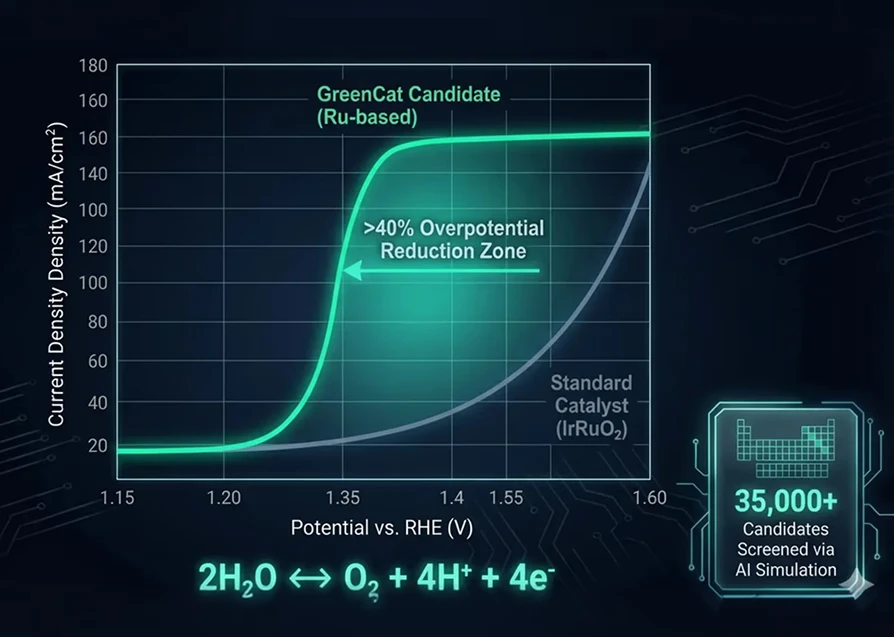
Other catalysis tools exist in the wiggle room of existing catalysts, yielding fractions of percent increase. At GreenCat, our scientists focus on the fundamental chemistry and physics to hit new global maxima in catalyst engineering. We take the blinders off and look at reaction mechanisms with a fresh set of eyes.
GreenCat's unique proprietary algorithm identifies ideal catalyst candidates rapidly using a global descriptor. Unlike traditional methods, our process does not require vast quantities of IP data to find potential candidates, we do fundamental science.
We begin by establishing comprehensive reaction networks for a given reaction system and a known catalyst surface. This ensures every possible path of the chemical transformation is accounted for before screening begins.
Using hypothetical catalyst reaction energy optimization, we identify the specific "descriptors" that determine a catalyst's performance. These descriptors allow us to navigate the "peak performance" landscape of potential materials.
We perform a descriptor-based screening process using scaling relations and prediction models developed from existing catalysts data. This allows us to search the entire periodic table to identify catalyst options that are currently unknown to science.
We perform activity comparisons of screened catalyst surfaces using a transferable partial reaction network. This step "sense checks" novel candidates so we only provide proposals that are both useful and relevant to your operational limitations.
The process culminates in the selection of a final catalyst formulation. These candidates are engineered to provide exceptional stability and resistance to catalyst poisons, ensuring extended lifespans in continuous industrial systems.
GreenCat works with some of the world's leading catalyst manufacturers, pharmaceutical companies, and chemical companies across various functions and reactions.
Let us help you find the best catalysts candidates within your operational limitations, without process disruption
Contact us